




Training a Puppy or Adult Dog to Potty Outside
It's not really that hard. Consistency is the key to success. Adult or puppy --- you need to set up a "potty" schedule. Regular visits to the area of the backyard you wish him to use will increase your pup's success at going where you'd prefer. You'll want to take the puppy or dog out about 20 minutes after eating or drinking, and immediately after waking from a nap and hard play. Be Patient - it takes time for him to understand what you want. Consistency is the key - take him out often and he will eventually prefer to do his potty duties outside.
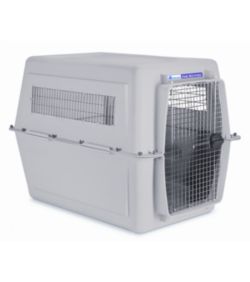
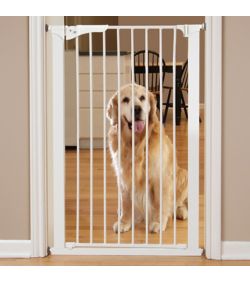
Never let your puppy or dog have free run of the entire house, it's important you know where he is at all times. That few seconds you don't - there WILL be an accident! Keep him near you so you will know when he has to go outside. One method of accomplishing this is called "tethering". You use a 6' leash tied to your belt so the puppy must follow you everywhere and can't wander off to find an inappropriate place to potty. Another is to confine him to the room where you are with baby gates. You need to be able to see him at all times. If he begins to whine, starts to squat, or just looks uncomfortable he may need to go outside. Every puppy will figure out his own way of asking eventually. We have some that will whine, some that pace, some that paw a door, some that give you the "look"....each puppy is unique so it's up to you to figure out his way of communicating that he needs to go. A very young puppy may need to be carried out (in order to make it that far), but an older puppy or adult can usually hold it until you go outdoors if you don't take too long getting him out there. When not with you, the puppy should be in a crate or confined to a small area. Dogs instinctually do not want to soil where they sleep, so you can use this to your advantage by keeping his resting place just large enough for him to lie down comfortably. If you own an x-pen, they are useful for confining a small puppy to a portion of a room (an x-pen is a portable circular fence with an opening that can be moved).
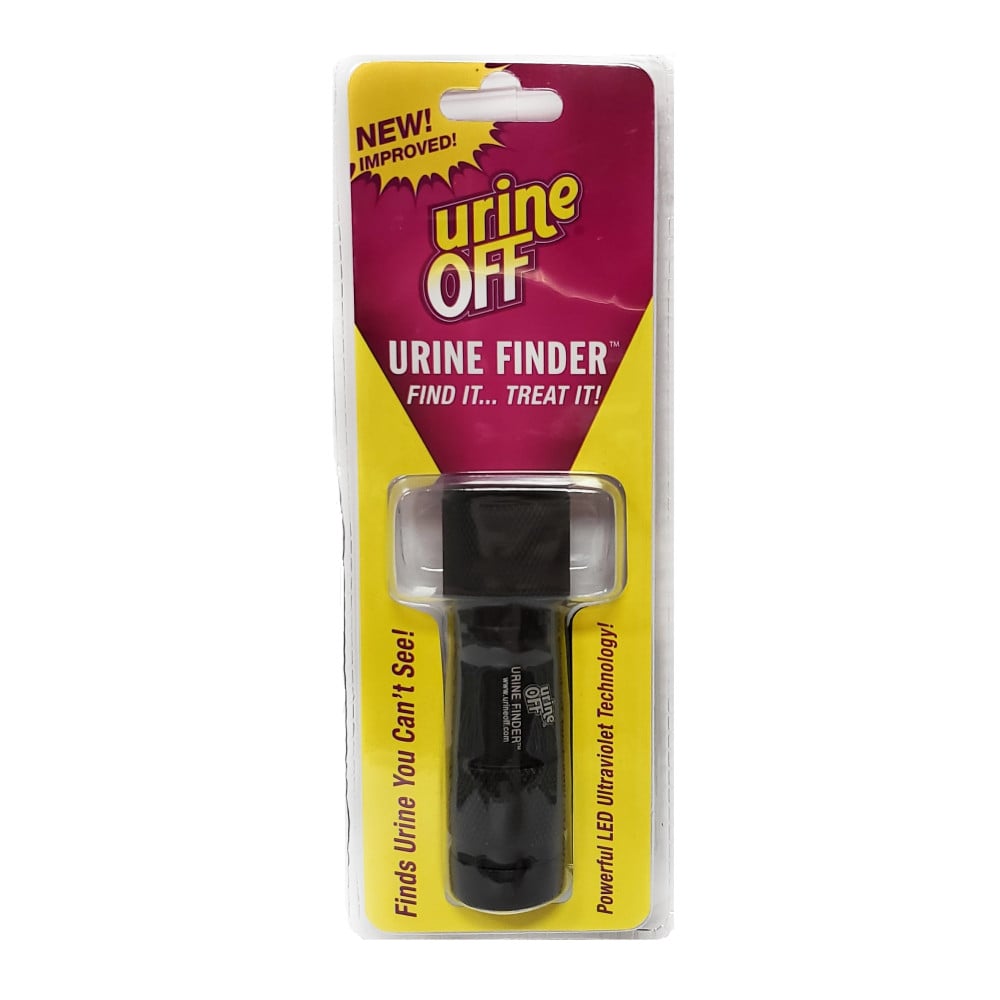
A good solution for working "parents" of a puppy is a utility room, checked for anything chewable or dangerous, and furnished with an open crate. Put in a "potty area" of newspapers or old towels (we use towels because it smells less). As the puppy gets older and can hold it longer, you eliminate the potty area. Never punish the puppy harshly for pottying in the house - no hitting, no yelling, no rubbing a nose in it! Rubbing a nose in urine or feces is an old wives tale and does NOT work - this does nothing but confuse your dog and may set back training. With an adult, you can grumble disapprovingly as you clean it up, but no more. An adult may know it's his mess and understand you are upset. He will not remember when or why he did it. A puppy may not even realize it's his so never scold any dog for an accident you don't see happening at that very moment. If you find an accident in the house - it's YOUR mistake - own it! You weren't watching closely enough! Use a good enzymatic cleaner to remove all traces of urine and feces from any accident areas and resolve to be less preoccupied next time.
Your puppy or dog should be on leash when being taken to the potty area. Use the word "outside" when you go out the door. When the puppy goes, say "good Potty" in a happy voice. By doing so you are giving what he's doing a name so that if you ever need him to go on command, he will understand what you want. That can be very helpful when away from home, or in an unfamiliar yard. When done, praise lavishly.
How long it takes for the puppy to be totally trained will depend on where you obtained the puppy, the dog's personality, but most of all, your consistency. A puppy that has someone home all day, every day working with him will learn faster than one that gets the mixed message of it's ok to use the indoor potty area while you are at work, but not ok when you are home. Petshop pups are VERY hard to train because they are used to being near their urine and excretement in a small cage - they had no opportunity to go elsewhere so learned to just do it where they sleep. While some breeders do much to start the process if the pups are raised in the house, others do not - particularly if they are raised in kennels. It can take a week to several months to reliably housebreak any puppy. A rescue or adult may take as long or longer, depending on his age and habits. An older dog that was a "kennel dog" may try very hard to please you, but also may have a more difficult time understanding just what you want.
Give any dog his indoor freedom slowly, starting with short periods and working up to longer times as you gain trust in his ability. A new puppy can hold it for only about 2 hours. A good rule of thumb is 1 hour per month of age....so a 3 month old puppy is good for about 3 hours. But that doesn't mean you shouldn't take him out more often if you can! Don't wait for the accident - prevent it. If that means going out 20x a day - so be it. They are only small for a short time and the better job you do at that age will bestow upon you a dog well trained for it's lifetime (barring health problems).
If you work outside the home you'll need someone to let the pup out (usually at a lunch break). Housetraining will likely go slower because you aren't there. A helpful hint: If puppy has deposited excrement in the house (accidentally - and it's ALWAYS an accident - puppies don't do it on purpose to make you angry or 'get even' or for any malicious intent), pick it up in a paper towel and take it outside to the potty area. It will help him understand where he SHOULD go next time.
Adult Malamutes can be quite stubborn about potty training and suddenly "forget" all they've learned when they are upset with you (from separation anxiety or inappropriate discipline for example). Not every Malamute will do this, but some Malamutes will let you know they are upset with a specific person by leaving a deposit in their "area". A good example is when Penny was upset with Dan, she'll leave him a "present" in his basement workroom to find. The workroom is essentially HIS area, so she was clearly telling him she was upset with something he did. She is an extremely clean and reliable dog in the house and can hold it several hours without a problem, but when she was upset with someone she would occasionally let them know this way. I've heard of others with Malamutes that do this on occasion. However, though it seems deliberate, it is still pointless to punish something you don't see happen - so the best thing to do in a situation like that is clean it up (with lots of grumbles that he can hear) and forget it. If you left the dog at home while going out, and it happens more than once, temporarily reinforce good behavior by using a crate for awhile. You need to discover the source of the anxiety or frustration for the dog and eliminate it. Star would leave us a puddle in the basement when we go out, but NEVER anywhere else in the house - a simple solution (since she is reliable about not getting into anything) is to let her stay upstairs. I would use the crate but she rubs her nose raw trying to get out. In her case, I'm not sure if it's anxiety or just frustration at being downstairs where she can't see out a window - but it works.
Spaying and neutering is always a good idea, no matter what. Marking territory is one reason for in-house urination in a male dog older than a few months. Occasionally some dominant female Malamutes will do this as well, but it's not nearly as common. Spaying/neutering may help in that regard IF the dog is pre-adolescent when it's done. After adolescence you can try neutering/spaying, but chances are it won't help that much. Potty-training will likely take longer for an older dog than a puppy - bad habits are hard to break and he may never be as reliable as you'd like so a regular schedule of "potty times" can help. Even dogs that are not very reliable will tend to be better if they know they can count on certain times they will always get to go outside. Simone was difficult to potty train - but eventually, once she realized she ALWAYS went out at certain preset times, she stopped having accidents.
Very few dogs are impossible to train - when there are problems it's usually something the owner is or is not doing. If problems continue, make sure you check out things like potential bladder infections, kidney problems, or other health issues before assuming the dog is just not learning. All dogs want to please and would rather go outside than have you be upset. A dog that regularly has accidents, or starts to have accidents after being trained may have a health problem you are unaware of. Rule this out first before you start over. If your dog backslides you'll have to start as if he were a puppy - crating, regular intervals, take him outside. All dogs want to be able to be housedogs (even the ones that spend lots of time outside). And the key ingredient to being a good housepet is good housetraining.
The END